

Quick answer
To run safely at night, make sure drivers can see you, choose a lit route you know, and tell someone where you are going. Wear reflective items on your wrists and ankles, carry a charged phone on your body, and keep your Health information up to date. If you fall and cannot call for help, an app like Z-KUR can detect the accident and a trained operator will check it before contacting the emergency services.
The clocks go back at 2am on Sunday 25 October. From the following Monday, many people who run after work will be heading out in the dark, and by mid-November it will be dark well before 5pm across most of the UK.
Running at night is not dangerous in itself. Thousands of people do it safely every evening. But three things change once the sun goes down:
drivers see you later, you see the ground less clearly, and there are fewer people around if something goes wrong. This checklist deals with all three.
Why running in the dark is different
- You are harder to see. Dark clothing at dusk can make a runner almost invisible to a driver until the last moment.
- You see less of the ground. Kerbs, potholes, tree roots and wet leaves are easy to miss, and autumn adds slippery pavements to the list.
- Help is further away. The canal path or park loop that is busy on a summer evening can be empty at 6pm in November. If you fall and hurt yourself, it may be some time before anyone passes.
Before you go out
- Tell someone your route and when you expect to be back. A quick message is enough. Agree what they should do if they have not heard from you.
- Charge your phone and carry it on your body. A phone left in a car or a bag at the start of the route cannot help you. A running belt or armband keeps it with you.
- Set up an emergency contact on your phone and add it to your lock screen, so anyone who helps you knows who to call.
- Keep your Health information up to date, including any condition, medicine or allergy the emergency services should know about.
- Choose a lit, familiar route for your first few dark runs. Save quiet trails and unlit lanes for the weekend daylight.
- Check the forecast. Rain and early frost make surfaces more slippery, and fog reduces how well drivers can see you.
Be seen
The Highway Code advises wearing bright or fluorescent clothing in poor daylight and reflective items in the dark. It notes that drivers can see reflective materials from up to three times as far away as non-reflective ones.
- Put reflective items where you move. Bands on your wrists and ankles catch headlights as your arms and legs swing, which helps drivers recognise a person rather than a post.
- Use lights as well as reflectives. Reflective material only works when a light shines on it. A small white light at the front and a red light at the back make you visible to people without headlights too, such as cyclists and other runners.
- Avoid an all-black kit. If you love your dark running jacket, add a bright or reflective layer over it.
See where you are going
- Wear a head torch on any stretch without street lighting. Point it slightly ahead of your feet, not straight down.
- Shorten your stride on unfamiliar ground. Shorter, quicker steps make it easier to recover if you catch your foot.
- Watch for autumn hazards. Wet leaves hide holes and edges, and from late November, early ice can form on bridges and in shaded spots before anywhere else.
On the road
- Face the traffic where there is no pavement. The Highway Code advises keeping to the right-hand side of the road so you can see oncoming vehicles.
- Keep one ear free. If you run with music or podcasts, keep the volume low or use one earbud, so you can hear cars, bikes and people around you.
- Cross where it is lit. Use crossings and junctions with street lights, even if it adds a minute to your run.
- Do not assume a driver has seen you. Make eye contact where you can, or wait.
If you fall or feel unwell
- Stop and stay still for a moment. Check for pain in your head, neck, back, wrists and ankles before you try to stand.
- If you are badly hurt, call 999 in the UK or 112 in Ireland. Both numbers also work across the UK.
- Keep warm. Body temperature drops quickly once you stop running, especially on a cold, damp evening.
- Let someone know where you are, even if you think you can make it home.
If you find another runner hurt
Call 999 or 112 first. If they may have hurt their head, neck or back, do not move them unless they are in danger where they are. Keep them warm and talk to them until help arrives. Our guide to what to do in a medical emergency covers the first steps in more detail.
Where Z-KUR fits
Every tip above assumes you can reach your phone and make a call. Sometimes that is not possible. A hard fall can leave you dazed, unconscious or unable to move.
The Z-KUR personal safety app was designed by three doctors for exactly that moment:
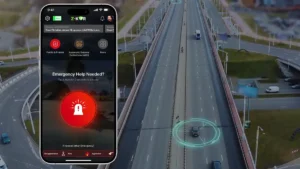
- It can detect the accident for you. Z-KUR uses your phone’s sensors for automatic fall detection. In manikin testing, which included running and cycling accidents, its algorithms detected 97% of incidents. You can read more about how smartphones detect falls and accidents.
- A trained person checks every alert. A sensor cannot tell whether you are conscious. That is why every detection is reviewed by a trained Kurator before anything reaches the emergency services. Across more than 30,000 hours of recording, zero false alerts have been passed on.
- The emergency services get what they need. Your location and Health information reach them through a direct, secure route.
- Trained help nearby. Z-KUR builds a network of trained bystanders, our First Aid Users, around you. You can read how Kurators and First Aid Users work.
Z-KUR is live with 999 across England, Scotland, Wales and Northern Ireland, and with 112 in Ireland.
Your night running checklist
Before you leave | While you run |
|---|---|
Someone knows your route and return time | Reflective bands on wrists and ankles |
Phone charged and carried on your body | Front and rear lights, or a head torch |
Emergency contact on your lock screen | Facing traffic where there is no pavement |
Health information up to date | Volume low, or one earbud only |
Lit, familiar route chosen | Crossing only where it is lit |
Frequently asked questions
Is it safe to run at night?
For most people, yes, if you plan ahead. The main risks are not being seen by drivers, tripping on surfaces you cannot see, and having no one nearby if you are hurt. Reflective kit, lights, a familiar route and telling someone your plans deal with most of them.
What should I wear to run in the dark?
Bright or fluorescent clothing, reflective bands on your wrists and ankles, and a light at the front and back. The Highway Code notes that drivers can see reflective items from up to three times as far away as non-reflective ones.
Should I wear headphones when running at night?
If you do, keep the volume low or use one earbud, so you can still hear traffic, cyclists and people around you.
What should I do if I fall while running alone?
Stay still for a moment and check for injuries before you try to stand. If you are badly hurt, call 999 in the UK or 112 in Ireland. Keep warm and tell someone where you are.
Does Z-KUR work while I am running?
Yes, as long as your phone is on your body. Running accidents were part of Z-KUR’s manikin testing, where its algorithms detected 97% of incidents. Every detection is checked by a trained Kurator before it reaches the emergency services.
Run with someone watching your back
Darker evenings do not have to mean giving up your evening run. Plan your route, make sure you can be seen, and keep a way to raise the alarm with you. Download Z-KUR before the clocks go back.
Z-KUR does not replace calling the emergency services. If you are able to call 999 or 112, always do so.